Table of contents
Intro
Welcome
Welcome to the Imagine Reality Lab (IRL)!
We are a brand-new cognitive neuroscience lab based at the Department of Imaging Neuroscience (the FIL) at University College London, led by Nadine Dijkstra. We study how our brain gives rise to the mental images that we see in our imagination, to what extent imagining relies on the same neural mechanisms as perceiving the external world, how, given these shared mechanisms, our brain keeps imagination and reality apart, and how changes in these processes could affect mental health.
This manual was developed by the lab PI, Nadine Dijkstra, and is heavily inspired by several others (particularly the lab manuals of Steve Fleming, Roy Salomon, Anne Urai, and Mariam Aly).
Getting started
Make sure to do these things within the first week of getting started:
– Read this manual
– Get added to the lab slack (ask Nadine)
– Get added to the Google Calendar (ask Nadine)
– Write a short biography to be added to the lab’s website
– Go through the induction training at the Department of Imaging Neuroscience (ask reception)
– Get a GitHub account and link it to the lab’s GitHub at https://github.com/ImagineRealityLab
– Read the background papers
– Fill out this Expectations Questionnaire prior to your first meeting with Nadine. There are no right or wrong answers, this is just a starting point to help manage expectations from the start.
Key background papers
To get a better idea of the types of questions that we answer in the lab, and to get more acquainted with our approach, please read the following papers:
– Shared neural mechanisms of visual perception and imagery – Dijkstra, Bosch & van Gerven 2019
– The neural mechanisms of perceptual reality monitoring – Dijkstra, Kok & Fleming 2022
– A neural basis for distinguishing imagination from reality – Dijkstra, von Rein, Kok & Fleming 2025
– The human imagination – Pearson 2019
– Brain mechanisms of reality monitoring – Simons, Garrison & Johnson 2017
– Cognitive computational neuroscience – Kriegerskorte & Douglas 2018
In addition, check out papers and preprints published by the lab in the last 12 to 18 months as these give a good overview of what we are currently working on.
Vision and Values
Research vision and values
Doing science well
With the joy of doing science comes the responsibility of doing it well (or at least the best we can). In general, we follow the European Code of Conduct for Research Integrity, which focuses on reliability, honesty (with ourselves and others), respect, and accountability. We should always be ready to share the reasoning behind our decisions and be open to learn more and improve our work. Concretely, make sure to:
- Make your work accessible. Share papers as preprints (on bioRxiv, arXiv, psyArXiv or OSF) and publish in open access compliant journals (see https://journalcheckertool.org/ to check). The rules can sometimes be complicated to navigate, so make sure to discuss with Nadine first before deciding on a specific journal.
- Report transparently. While writing in an engaging way is important, it should never come at the cost of scientific honesty. Never oversell your findings or try to hide unexpected findings. If you do not find what you expected, treat that as a learning opportunity and not a failure; if we already knew for sure what we were going to find we wouldn’t have needed to do the research!
- Produce code that you can share with others. To be able to share our code and also ensure that the results that we report are correct, our analysis code needs to be organized and well documented. Make sure to write your pipeline so that you can easily reproduce all the steps from raw data to key figures in a way that others can follow. Make plenty of comments and document key milestones in your reasoning. This is hard work and we are often impatient to just get it done so we can move on and see our results but doing this right can save you a lot of work later and also means that others can build on what you’ve done.
- Share data. Within the lab, you should always feel free to share any data you have. Outside the lab, we aim to make all data freely available upon publication of the associated manuscript, but in some cases, there might be exceptions to this rule (e.g. if the data cannot be anonymized). To facilitate the process of data sharing, it is important to organize and document the data clearly.
Keeping an open mind
We are in the business of trying to find answers to questions. However, it is human nature to develop biases. Once we have found a nice sounding explanation for some phenomenon, there is a danger to develop tunnel vision and focus on evidence that confirms rather than challenges our ideas (click here for an example of how this played out in research on the role of the amygdala in fear). As scientists, we have the responsibility to be wary of such tendencies. In the lab, we place high value on questioning and challenging each other. Make sure always to do this in a helpful and respectful way and from a place of wanting to make the science better, not put down your colleagues. Help each other think through alternative explanations for the data and ways to test these and then collaborate in executing these experiments and discovering new things.
Culture vision and values
Figuring out how the world works, for the sake of knowledge itself, is a vital human endeavor. Curiosity-driven basic science – wanting to know how something works – can have unexpected benefits later down the line and can also be a wonderful occupation; you get to spend your days solving problems that you’re passionate about while working with smart and enthusiastic people. In the IRL lab, we aim to create a positive, engaging, challenging and inspiring environment where people from diverse backgrounds can follow their scientific curiosity. In turn, we expect everyone in the lab show a real commitment to and passion for research as well as be dedicated to maintaining a good research culture.
Well-being
Nadine is of the strong opinion that happy scientists do better science and prioritizing well-being is one of the lab’s core values. Being stressed will prevent you from harnessing your creativity and curiosity to the fullest and therefore taking care of your wellbeing should be one of your top priorities. The notion of the ‘stress-bucket’ used by Mental Health UK can be helpful to keep your stress levels in check. It is important to make sure that you maintain a good work-life balance. Most of us get into science because we are passionate about our topic and therefore might be inclined to spend all of our time on it. However, to be able to do science sustainably in the face of all the challenges and insecurities that come with it, it is essential to maintain a life outside of science that can help you recharge.
There are unique challenges that come with being a scientist. Our work puts us at the limits of human knowledge, constantly veering into the unknown. By design, there is a lot of uncertainty surrounding our work and concrete feedback that your efforts have led to the desired outcomes often only comes after months or even years of designing experiments and collecting and analyzing data. As Weiji Ma said: we are professional doubters, so doubting ourselves is a real occupational hazard. It is therefore not surprising that imposter syndrome is very common amongst scientists. While it is essential to keep an open mind and acknowledge the limits of your knowledge, it is just as important to trust that you have made it to this stage for a reason. You are clearly bright, motivated and resourceful and able to make valuable contributions to science.
If you struggle with mental health, know that you are not alone, and that resources are available. There are several trained Mental Health First Aider’s at the department (Nadine is one of them) that can point you to relevant resources at UCL. You can also always talk to Nadine in confidence if there has been a change in your professional or personal circumstances that require adjustments to your work or if you want advice about how to handle specific professional challenges. You should also tell Nadine if you feel like your workload is becoming too much – sometimes we underestimate how much work something is going to be and it is important to be open about this.
Commitment to diversity
We are committed to creating an inclusive environment in the lab where people from diverse backgrounds can thrive. Besides the fact that it is just the right thing to do, increasing diversity has time and time again been shown to lead to better performance: people with different backgrounds will have different ways of thinking which increases creativity and innovation; a more diverse team will help make people feel safer to speak their minds; and more perspectives and ideas can accelerate problem solving. While obviously great in principle, academia has unfortunately proven to not always have the most inclusive culture. To make things better, it is essential that everybody tries to do their part to make academia a more equitable and inclusive environment. Therefore, everybody is encouraged to reflect on the ways in which academia excludes people from certain backgrounds, what the consequences of that are for the kind of science we do and whether there are (small) steps we can take to make things better.
We have a zero-tolerance policy for any form of harassment, sexism, racism, homophobia, transphobia or any other form of bigotry. Should you become aware of any form of misconduct, notify Nadine immediately. If Nadine is the cause of your concern, you can talk to the Head of Department or another trusted faculty member. If you are uncomfortable speaking to anybody directly, UCL has a very helpful system where you can get support, even anonymously. We adhere to UCL’s Code of Conduct, make sure you familiarize yourself with its recommendations.
Expectations and Responsibilities
Everybody is expected to:
– Adhere to the research and culture values set out in the Vision and Values section above.
– Work on something you’re passionate about, work hard and do it in a way that makes you proud of what you do.
– Be supportive of your colleagues, we are a team.
– Keep up with the latest developments and think about ways to improve the work we do. This can be in terms of scientific methods, analyses, sharing data and code, open science, research culture, diversity, etc.
– Making mistakes is a part of being human. When you make a mistake (notice the deliberate ‘when’ and not ‘if’), don’t try to hide it but be open about it, even if the paper is already written and even if it’s already published. You will never be shamed for making a mistake and we will work together to fix it. As scientists, we try to find out the truth, and we cannot do that if we ignore mistakes.
– While making mistakes is part of being human, you should try to prevent them by making sure not to rush (good science takes a lot of time!), double and triple checking your work and asking others for help if something looks off.
– Know the limits of your knowledge and don’t be afraid to ask questions. Similarly, know that others also don’t know everything so don’t be afraid to respectfully challenge them if you think they are wrong (yes, that definitely also includes Nadine). We are all here to learn!
– Knowing how long to keep trying something, and when to ask for help, is a tremendously useful skill. A useful guideline: if you know what next steps to take (keywords to Google, instructions to follow, control analyses to run) then take them first. If you can no longer identify how to move forward, don’t waste time being stuck and ask for help or advice.
– Take a proactive role in your career development. Think about what kind of career you want and how to get there. Nadine is always happy to chat about this if helpful.
General Policies
Authorship
Like other labs, we will follow the APA guidelines with respect to authorship:
“Authorship credit should reflect the individual’s contribution to the study.”
At the start of a new project we will discuss authorship. Nadine will typically be the last author and the person leading the project will typically be the first author. Authorship will primarily reflect the contribution to the project. We will try to make this clear in advance so no surprises occur, but if authorship needs to be updated at a later stage because, for example, somebody leaves and roles change, this will be discussed explicitly at that time.
Working hours
Being in the office during core UCL office hours – Mon-Fri between 10am and 4pm – builds camaraderie, facilitates learning from and helping each other, and sparks ideas that you usually wouldn’t have by staying home, so try to be physically in the office those hours as much as you can. That being said, one of the advantages of academia is its flexibility. As long as you attend the required meetings, are present for data collection, and get your work done, you can decide which hours work best for you and whether you prefer working at home or in the office. Regardless of exactly how you prefer to work, you should still treat this as a job and not work more than your contracted hours.
Communication
Most direct communication is via Slack (make sure you are added to the lab Slack as soon as you start). We will use Slack for direct messaging about projects and general questions, lab announcements and sharing resources and papers. Check Slack at least once a day during weekdays so that issues can quickly be addressed and you are up to date about any announcements. Nadine might sometimes respond at unusual hours due to traveling etc. but you should never feel obligated to respond outside of working hours.
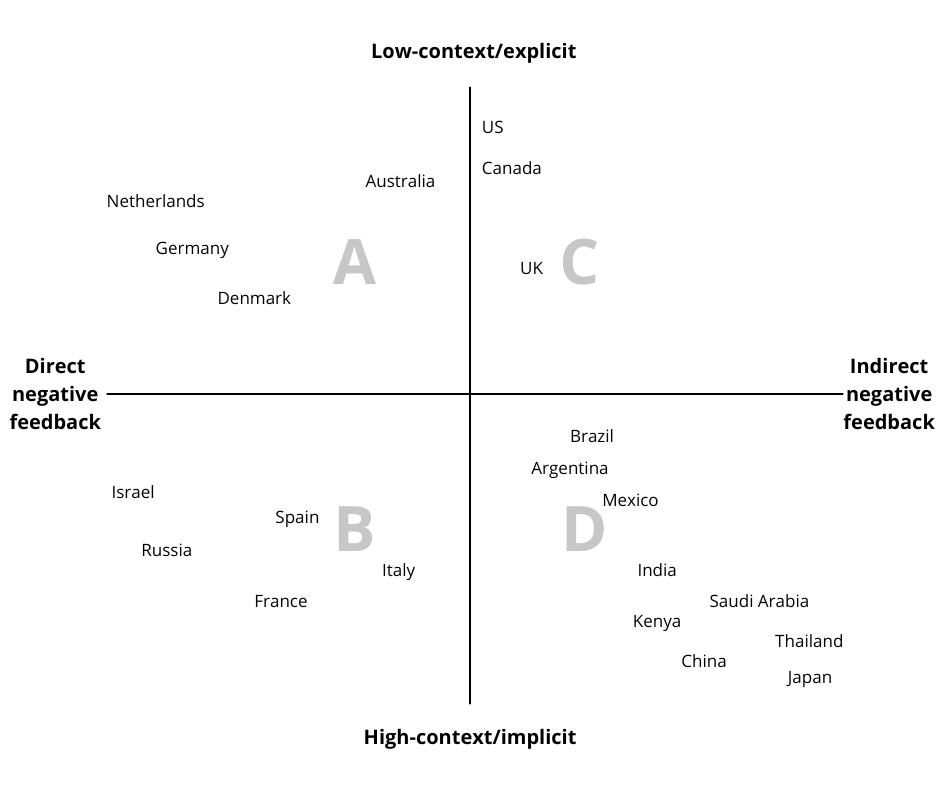
From “The Culture Map” by Erin Meye, 2014, PublicAffairs™, 166 (1), p.47.
In a culturally diverse environment like academia, it is important to be aware that communication styles and preferences can vary a lot between cultures (see figure above). Try to keep these potential differences in mind when communicating with colleagues, students and supervisors. Most of the time, miscommunications are due to incorrect assumptions rather than bad intentions. As an example, Nadine is from a ‘low-context and direct negative feedback’ culture, which means that her communication tends to be very direct, and that she might sometimes miss something when it is communicated in a more subtle way.
Meetings
Individual meetings
When you start at the lab, you will set a schedule for regular meetings with Nadine. This usually means one 1-hour slot every week at a fixed time. Some weeks you might not have enough to discuss, in that case, feel free to cancel or shorten your weekly meeting. Some weeks we might only need a 10-minute check-in while other weeks we need the full hour. Meetings might occasionally need to be rescheduled. Make sure to come to your meeting prepared with what you want to discuss.
Other meetings/talks
*At the department of imaging neuroscience*
– Project presentations are given on Friday afternoons at 2PM for any new project that will require scanning at the department. These presentations are a great way to stay up to date about what research is going on at the department, learn about state-of-the-art techniques and see what kind of questions you might expect when the time comes for you to present your own project! Project presentations are hybrid in the 4th floor seminar room at the FIL and on Teams.
– Brain meetings are given on Fridays after the project presentations, starting at 3.15PM. These are seminars given by world-renowned experts on a variety of different topics. Brain meetings are hybrid at the 4th floor seminar room and on Zoom. Try to attend both project presentations and brain meetings regularly as it is a good way to be involved in the department and make connections.
– The Methods Clinic is on Monday’s at 12.30 on Teams. This is a weekly support session where you can ask brief questions related to the design and analysis of neuroimaging experiments, with a focus on SPM (the software we use for analyzing fMRI data). Hosted by Karl Friston (scientific director), Peter Zeidman (head of SPM) and other members of the Methods Group. No need to book.
*At other departments*
– Consciousness Club is an online seminar series co-hosted by Steve Fleming and Nadine which brings together “an interdisciplinary audience of colleagues in various fields of cognitive science, neuroscience, psychology and philosophy with a mutual interest in consciousness science”. The exact time of these talks varies depending on the time-zone of the speaker.
– One of the advantages of being at UCL is that it is possible to go to an interesting talk almost every day! Besides the brain meetings at the FIL, there are also regularly interesting talks at the ICN, MPC, Experimental Psychology and at Birkbeck University, all within a few minutes walk of the department.
In general, it is very valuable to go to talks, learn about new research and get more concrete examples of how (not) to present your research, but given time limits, try to prioritize the talks that are most relevant to you and make sure you still have enough time to do your research!
Programming languages
In the lab, we predominantly use SPM and FieldTrip for fMRI and MEG analyses, which are MATLAB based. For online studies, we tend to use JsPsych. That being said, there are clear advantages to using open source languages like Python or R. Given this tension, we will make decisions about which programming language to use on a case-by-case basis.
Deadlines
People differ in whether or not they work well with deadlines. There are not a lot of fixed deadlines in academia, which has the danger of making things drag on too long. Talk to Nadine about whether setting clearer deadlines will help you.
Conferences
Attending conferences is a great way to stay up to date on the latest research and to connect with other researchers all over the world. You will generally be able to attend one or two conferences a year, depending on the stage of your project and the location of the conference. Discuss with Nadine if there is a conference you’re interested in attending. The following conferences are generally aligned with the work we do, but feel free to suggest other ones that you are interested in:
– Computational Cognitive Neuroscience (CCN)
– Vision Sciences Society (VSS)
– Association for the Scientific Study of Consciousness (ASSC)
– European Conference on Visual Perception (ECVP)
– British Association for Cognitive Neuroscience (BACN)
– International Conference on Cognitive Neuroscience (ICON)
Thank you
For taking the time to read this manual. If you have any comments or suggestions for the manual, please let Nadine know. We hope you have a great and productive time in the IRL lab!
 Welcome